


Baku hosts international conference on Security and Cooperation in the South Caucasus
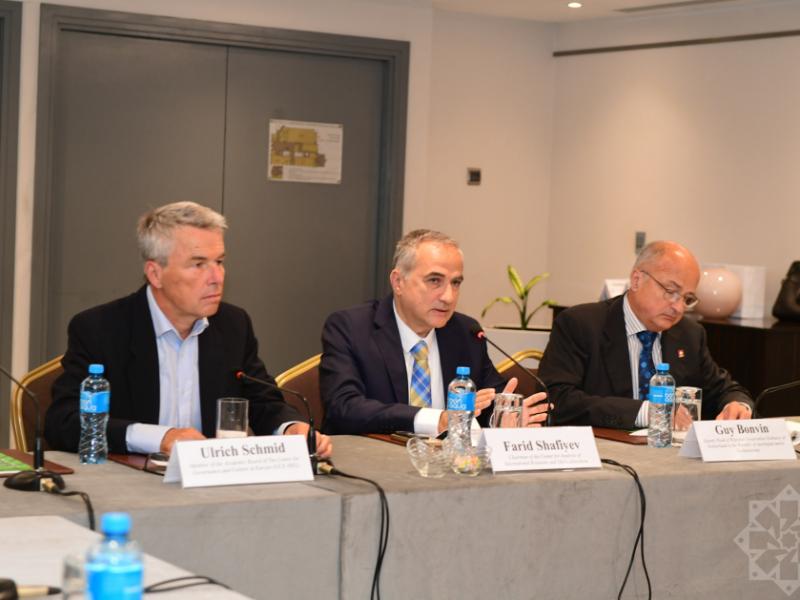
Co-organized by the Center for Analysis of International Relations (AIR Center) and the Center for Governance and Culture in Europe (GCE-HSG), an international conference themed ‘Security and Cooperation in the South Caucasus’ was held in Baku.
The conference featured discussions on the new regional order that has emerged following the liberation of Azerbaijan’s territories, the impact of cultural, academic, and civil society encounters on reconciliation and recovery, the correlation between the Middle Corridor and connectivity in the South Caucasus, the TRIPP initiative, the role of the United States in advancing the region’s connectivity architecture, and the prospects for an integrated South Caucasus connectivity system.
Addressing the conference, Farid Shafiyev, Chairman of the Center for Analysis of International Relations and Multiculturalism (AIR Center), said that Azerbaijan’s geographical position and the implementation of major transport initiatives have transformed the country into a vital bridge between the existing geopolitical conflicts in the North and South.
“In this regard, the Middle Corridor initiative, spearheaded by Azerbaijan, is of paramount importance for boosting the region's economic and transit connectivity,” he noted.
According to him, Azerbaijan occupies a special place in these discussions, owing both to its strategic geographic location and the regional initiatives it has spearheaded.
Ulrich Schmid, a member of the Academic Council of the Center for Governance and Culture in Europe, highlighted that the developments taking place in the South Caucasus and the opportunities created by the new peace initiative between Azerbaijan and Armenia for regional cooperation.
Guy Bonvin, Deputy Head of the Regional Cooperation Section of the Swiss Embassy in Azerbaijan and Turkmenistan, noted that the geographical position of the South Caucasus turns the region into a vital connecting point between Europe, the Black Sea and Central Asia.
The first panel of the international conference titled “The South Caucasus After the Second Garabagh War: A New Regional Order” brought together experts to discuss Azerbaijan’s evolving geopolitical role, foreign policy, regional ownership, and its approach to non-alignment amid competing regional dynamics.
The session was moderated by Alexander Meienberger, Director of the Center for Governance and Culture in Europe (GCE-HSG), expert in governance, regional politics, and socio-political transformation.
Keynote speakers included Jordi Xuclà, Spanish lawyer, academic, and politician from Catalonia; former member of the Congress of Deputies and the Senate of Spain, Michaël Levystone, Co-founder of the Observatory of New Eurasia (ONE) and an expert on Central Asia and Russia’s foreign policy toward Asi, and Anar Valiyev, Associate Professor of Public Administration at ADA University, specializing in post-Soviet public policy, governance, democracy, and urban development.
The discussions examined the transformation of the South Caucasus following the Second Garabagh War and Azerbaijan’s increasingly prominent role in shaping the region’s emerging political and geopolitical order.
As part of the conference program, participants are invited to join an info-tour to the Garabagh and East Zangezur economic regions, which will feature field research opportunities, allowing attendees to witness firsthand the devastation inflicted during the occupation, as well as the ongoing, large-scale restoration and reconstruction efforts in the region.
The info-tour will cover Aghdam, Jabrayil, Fuzuli, Shusha, and Lachin.